I know one great way to start off the new year — Check out my new paper on “Detecting signals of seasonal influenza severity through age dynamics” in BMC Infectious Diseases!
What is this paper about?
Typically, when we think about severity in the context of epidemiology, we ask: “Of all of the people who have this condition, how many or them died or were hospitalized by its symptoms?” These measures, also known as the case-fatality or case-hospitalization risks, are standard ways of quantifying the severity magnitude of a disease.
Unfortunately, it’s really challenging to estimate how many people get influenza every year and only a small subset of the population gets ill enough to die or become hospitalized.
- At the population-level, we can only observe the sick individuals that report their illness in some way (e.g., those that visit the doctor, buy drugs to combat flu, call in sick for school or work, or complain about symptoms on social media). It’s possible that all individuals with symptoms might be captured across multiple data sources, but how do you combine information from hospitals, drug companies, and Twitter in a meaningful way?
- Many flu cases are asymptomatic — people themselves may not even know that they are sick. These asymptomatic individuals can still transmit the virus to others — some immune systems might be strong enough to fight off the virus without generating symptoms, but people receiving the infection from asymptomatic individuals can still end up feeling crummy.
- We don’t usually test for flu among individuals that go to the doctor. In most cases, identifying the specific virus that is causing your symptoms won’t change the treatments they will prescribe, so it’s not often useful to confirm that influenza virus is the source of illness. They’ll prescribe you general antiviral drugs and send you back home for bed rest.
- The elderly and young toddlers are most at risk for mortality and hospitalization. Functionally, existing flu severity metrics focus only on the outcomes of these two age groups.
How can we capture information about the severity of a flu outbreak with fewer data sources and for a greater portion of the population?
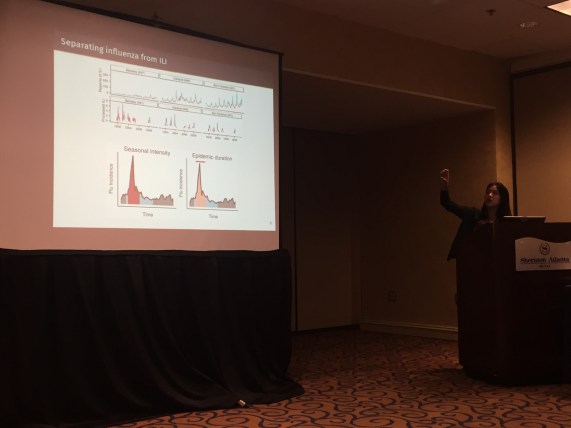
In this paper, we use routinely available flu surveillance data to identify age patterns among working-aged adults and school-aged children in “influenza-like illness cases” (unconfirmed sick cases that look like they could be flu) that are consistent across multiple flu seasons in the United States. We use these observed age patterns to create a new severity index; this index has some demonstrated capacity to detect severity early on in the flu season. We compare this new index to other quantitative severity benchmarks and examine data at the level of the entire U.S. and across different states. Public health officials may be able to use these measures to inform communication strategies during the course of an outbreak.
Bottom line: We suggest that it may be possible to use the relative risk of influenza-like illness between adults and children in imperfectly sampled data sources to estimate flu severity in the entire population.
Click here to read more!
We will be posting the code for these analyses on Bansal Lab Github in the coming weeks. Stay tuned for details!




 Elizabeth C. Lee